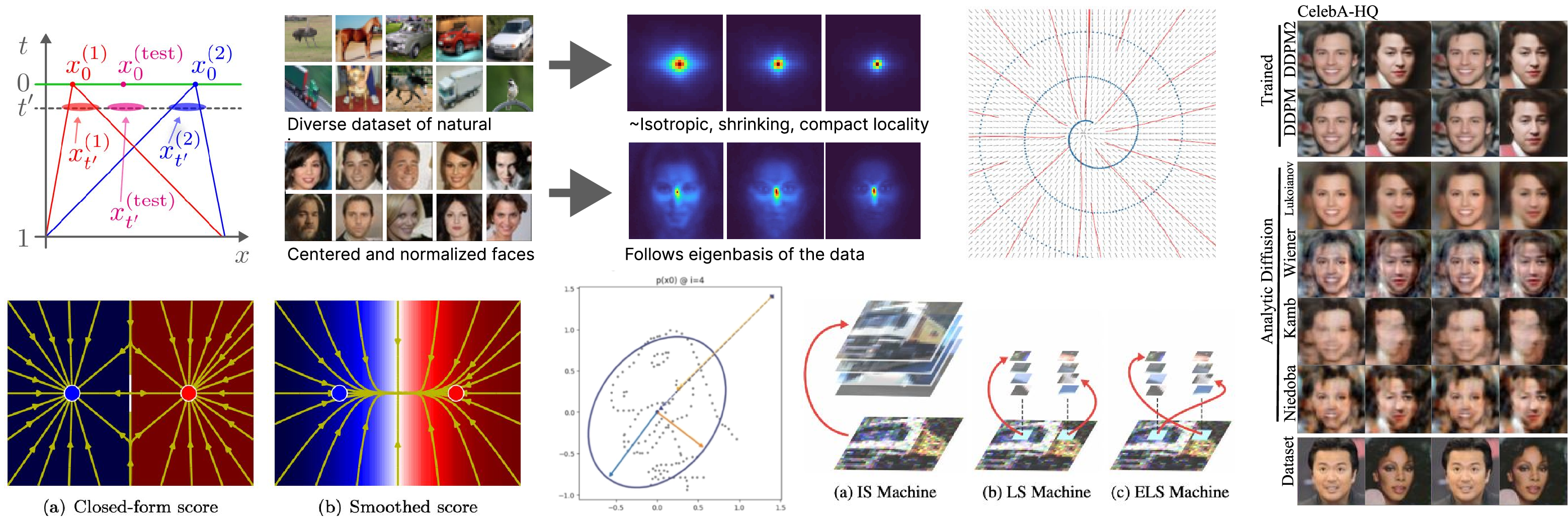
A deep dive into the mathematical foundations and analytic perspectives behind modern diffusion-based generative models.
The tutorial runs for a full day and combines lectures with interactive hands-on sessions.
| 8:30 – 9:10 | |
| 9:10 – 9:20 | Coffee Break |
| 9:20 – 10:30 | |
| 10:30 – 10:50 | Coffee Break |
| 10:50 – 12:00 |
How far can the linear perspective get us?
by Binxu
|
| 12:00 – 13:30 | Lunch Break |
| 13:30 – 14:30 |
Seeing generalization through locality
by Mason
|
| 14:30 – 14:40 | Coffee Break |
| 14:40 – 15:10 |
Why do diffusion models learn to be local?
by Artem
|
| 15:10 – 15:20 | Coffee Break |
| 15:20 – 16:00 |
How do diffusion models learn and encode global structures?
by Zahra
|
| 16:00 – 16:10 | Coffee Break |
| 16:10 – 17:00 | |
| 17:00 – 19:00 |
Analytic Diffusion Social
An informal gathering to chat about analytic diffusion models, right after the tutorial. On the terrace outside the Bluebird Ballroom (3rd floor, west-most side of the terrace).
|
Denoising diffusion models have achieved state-of-the-art results for generative modeling across images, video, and audio. Yet analysis of the training objective reveals a paradox: the objective admits a unique closed-form solution that is a function of the training data alone—and this solution can only reproduce training examples, exhibiting perfect memorization.
How, then, do deep diffusion models generalize? This tutorial explores the emerging family of analytical diffusion models that shed light on this question. Starting from the fundamentals, we build toward the current understanding of generalization mechanisms—score smoothing, inductive biases of neural architectures, training dynamics, and data geometry—all through the lens of optimal denoising.
The tutorial combines lectures with hands-on Jupyter notebook sessions so that attendees can run experiments, probe the theory, and build intuition firsthand.
Analytic Diffusion Studio is a modular codebase for training-free analytical diffusion models.
Use it to reproduce the methods discussed in this tutorial, run your own experiments, or build new analytical denoisers—no training required, just uv run.
$ git clone https://github.com/analytic-diffusion/analytic-diffusion-studio.git
$ cd analytic-diffusion-studio
$ uv run generate.py --config configs/pca_locality/celeba_hq.yaml